U.S. Senator Lisa Murkowski (R-Alaska), Chairman of the Senate Committee on Indian Affairs, led an oversight hearing titled: “Economic Self-Determination in Action: Examining the Small Business Administration Native 8(a) Program.”
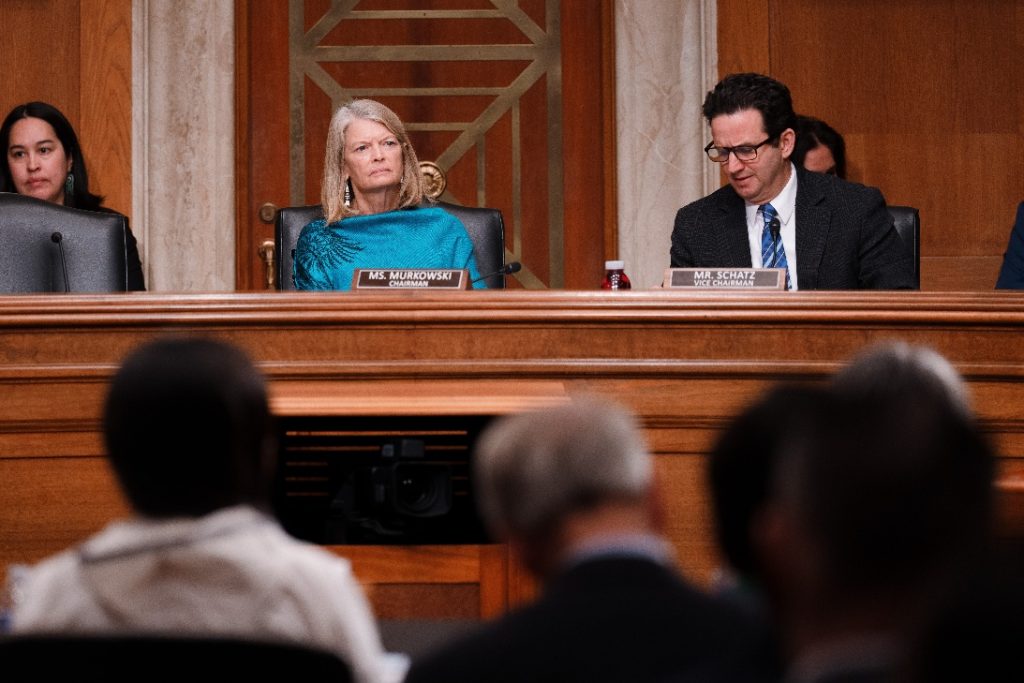
(Official U.S. Senate photo by Daniel Lightfoot)
During a recent hearing, Chairman Murkowski highlighted the critical role of the SBA Native 8(a) program, firmly rejecting claims that it is illegitimate or based on DEI initiatives.
“This program is a success story. It’s not a fraud, as some have alleged, Murkowski said. “Quite honestly, that’s terminology that I would just categorically reject.”
Murkowski emphasized that the program strengthens federal procurement while advancing economic self-determination in Native communities nationwide. The Chairman also addressed recent criticism, making clear that Native participation in 8(a) is not rooted in DEI.
“It was not based on race. It was not based on DEI, but it was based on Congress’s constitutional authority over Indian Affairs and a longstanding federal trust responsibility to Native peoples,” Murkowski said.
Murkowski warned that restricting the program would undermine the benefits to both federal agencies and Native communities.
“In truth, it would actually cost the federal government a key contracting tool and further disadvantage Native peoples around the country,” Murkowski said.
Senator Murkowski’s full opening statement can be found here.
Expert witnesses during the hearing included:
- The Honorable Chuck Hoskin Jr., Principal Chief, Cherokee Nation, Tahlequah, OK
- Ms. Katherine Carlton, President, Chugach Alaska Corporation; Policy Chair, Native American Contractors Association, Anchorage, AK
- Ms. Polly Watson, Vice President of Operations, Bristol Bay Native Corporation, Anchorage, AK
- Ms. Cariann Ah Loo, President, Native Hawaiian Organizations Association, Honolulu, HI
During the hearing’s Q&A, Chairman Murkowski stressed that heightened scrutiny of the Native 8(a) program stems from some misunderstanding of the history and purpose of 8(a). She highlighted the tangible benefits it has delivered to Native communities.
“These are substantive. These are real. These are meaningful, and they are making a difference, just as the obligation that we have under the federal trust responsibility requires,” Murkowski said.
Ms. Carlton reinforced that the 8(a) program is the economic engine behind Native self-determination.
“The missing piece from this structure was the economic engine, and the 8(a) program filled this gap,” Carlton said.
Ms. Watson highlighted the program’s generational reach. “My presence here today is the symbol of the real impact of the 8(a) program,” Watson said. “The program connects economic development to long-term self-determination and creates opportunities that extend across generations well into the future.”
Senator Murkowski asked witnesses how the Native 8(a) program benefits shareholders in remote communities, emphasizing that the program’s impact extends beyond simply bringing “cash into the villages.”
“The reality is, many of the villages for your shareholders are extraordinarily expensive to live,” Murkowski said, noting examples like $1,600 to travel from Perryville to Anchorage and the high cost of basic building materials. “When we say cash into the village, it is helping to offset the extraordinarily high cost of living.”
Chairman Murkowski reinforced that the 8(a) program delivers measurable results for federal agencies:
“We’ve heard of the benefits that the program brings to the federal government… The federal government doesn’t have to come back to the 8(a) contractor. They do it because they’re getting good value and the performance is good.”
Senator Markwayne Mullin (R-OK) highlighted how Cherokee Nation leverages federal contracting to fund tribal government programs. Mullin asked Chief Hoskin about the flow of profits from Cherokee Nation-owned businesses and the direct impact of federal contracting on local communities. He emphasized that these funds allow the Tribe to respond rapidly to community needs and support both Native and non-Native populations.
“Rural northeast Oklahoma would hurt incredibly bad if suddenly contracting was sucked out of the economy,” Mullin said. “…just from federal contracting, some of that $10 million went immediately into scaling up a law enforcement system.”
Senator Mullin’s remarks can be watched here.
Senator Steve Daines (R-MT) acknowledged how the 8(a) program supports tribes in Montana.
“The Small Business Administration’s 8(a) program has helped tribally operated businesses in Montana grow and serve their communities,” Daines said. “Without a significant tax base, tribes must find creative ways to fund government functions and social services or rely entirely on federal funding.”
Daines highlighted specific Montana companies that have benefited from the program and emphasized their proven track records.
“Tribally owned entities like S&K Technologies and Buffalo Horse, Inc. use the 8(a) program to enhance self-determination and build long-term economic sustainability,” Daines said. “They welcome oversight, condemn fraud, and have proven records over several years.”
Senator Daines’ remarks can be watched here.
###